Sep 14, 2026
A Tree We Must Not Water: An Appeal to the People of Embu
What Happened
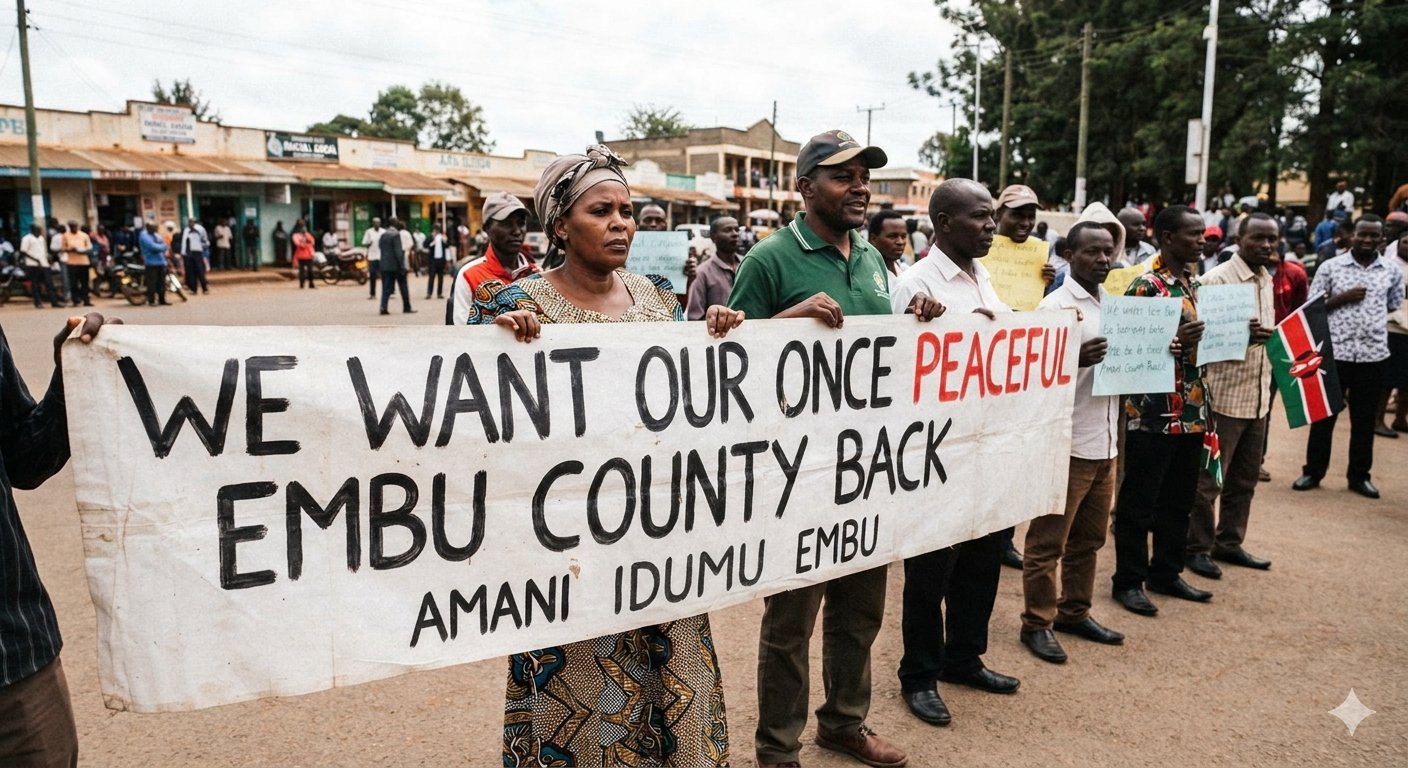
On Saturday, September 12, 2026, a political meeting at Nembure Stadium meant to draw more than 20,000 grassroots UDA officials from across Embu descended into exactly the kind of chaos this county has never been known for. A group attempting to storm the venue clashed with riot police; one person was shot dead, six vehicles were torched, three more vandalised, and several people — including a journalist and a UDA supporter struck in the face by a flying stone — were injured. Deputy President Kithure Kindiki, in the county alongside Governor Cecily Mbarire, had to be evacuated as officers moved to restore order. The youths, repelled from the stadium, regrouped afterward and spilled onto the road, attacking drivers and residents who had nothing to do with the meeting at all.
In the days since, the political blame has flown in every direction — accusations that a local MP incited the violence, counter-accusations that police themselves attacked a nearby church, claims of an unjustified manhunt, denials, and counter-denials. That noise is now a national story. What should matter more to us, as Embu people, is what it has already cost us and what it threatens to cost us next.
This Is Not Who We Are
Believe me or not, what we are witnessing here is not a good sign, and it is not a good tree to plant in the centre of Embu. We have watched, for years, as the names Kisumu and Kibra became shorthand nationally for political unrest — places where an election season means barricaded roads, torched buildings, and residents bracing rather than voting freely. That reputation did not arrive in those places overnight, and it has not left them easily. It took root the same way this is starting to take root here: ordinary disagreements between political camps, watered again and again with the excuse of "affiliation," until violence became the expected weather rather than the exception.
If we keep watering this tree in the name of political affiliation — if we make excuses for it because it was "our" leader's supporters or "their" leader's supporters — we will wake up one election cycle from now and find Embu spoken of in exactly those terms. That is not a legacy any of us should want for this county, and it is not one our children should inherit from a moment of political heat that will be forgotten by everyone except the families of those hurt in it.
Development and Violence Cannot Share the Same Ground
Trust me on this: Embu needs a great deal of development, and development needs peace to stand on. Roads, hospitals, markets, schools — none of it gets built faster because a county has a reputation for political goons. If anything, the opposite happens. Investors do not choose volatility. Development projects are delayed, sometimes abandoned, wherever the risk of political violence makes them unsafe to execute. Every vehicle torched, every stadium turned into a battlefield, every headline about "chaos in Embu" is a headline that makes the next investor, the next contractor, the next development partner think twice about choosing us over a calmer county down the road.
We cannot, in good conscience, demand the roads, the hospitals, the jobs that leaders promise us, while simultaneously creating the very instability that scares those investments away. We would be sabotaging our own future with our own hands, in the name of a political fight that will be over long before the damage is repaired.
What Embu People Should Ask of Their Leaders — and of Themselves
Whatever the truth turns out to be about who organised what on September 12 — and it deserves a real, impartial investigation, not a partisan one — every leader with influence in this county, regardless of camp, has a duty to publicly and unambiguously reject the use of youth as instruments of political violence. Not a carefully worded statement that blames only the other side. An honest one.
But leaders alone did not plant this tree, and leaders alone cannot uproot it. It survives because ordinary people are willing to be recruited into it, cheer it on from a distance, or excuse it because of who it appears to benefit. Embu's peace was never the government's to protect alone — it was ours to keep. It still is.
We have a choice, right now, before this tree grows any deeper roots: water it with affiliation and silence, or starve it by refusing — publicly, loudly, as neighbours and as a county — to let our home become the next headline. I know which one I am choosing.